Aboboyaa on Ghana’s Highways: Is a Ban the Answer?
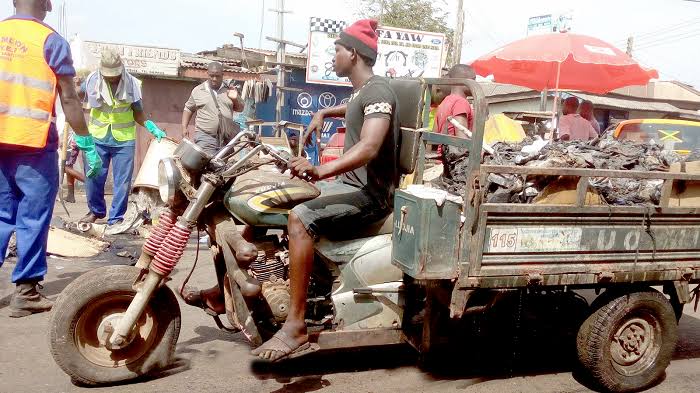
BY; Regina Bless
The tragic multiple-vehicle crash at Ofankor Barrier on the Accra–Nsawam Highway has once again exposed the dangers associated with the increasing use of motorised tricycles, popularly known as aboboyaa, on Ghana’s major highways.
The crash, which occurred in the early hours of Thursday, August 13, 2026, involved seven vehicles, including a tricycle, two tipper trucks, two Sprinter buses and two saloon cars. The National Road Safety Authority has since confirmed that 12 people lost their lives, while 22 others were receiving treatment at various hospitals.
Preliminary information from the NRSA indicated that a broken-down aboboyaa was stationary on the highway before the chain of collisions occurred. A tipper truck reportedly stopped behind the tricycle, followed by two Sprinter buses, before another tipper truck approached at speed and crashed into the vehicles. However, the NRSA has cautioned that this is only a preliminary account and that the official police report is needed to establish the exact cause of the crash.
The tragedy has therefore renewed calls from some stakeholders for a ban or stricter restriction on aboboyaa operations on major highways.
Can Ghana ban aboboyaa from the highways?
The answer is yes, restrictions are possible. In fact, Ghana has previously attempted to restrict tricycles from major highways and principal streets.
In 2021, the Greater Accra Regional authorities announced restrictions on tricycles using major highways, including the Tema Motorway, with the intention of eventually limiting their operations to their respective assemblies. The move was linked to enforcement of the Road Traffic Regulations, 2012 (L.I. 2180).
The challenge, however, is not simply announcing a ban. The bigger question is how effectively such a policy can be enforced.
The problem of unregistered and non-compliant tricycles
One of the biggest concerns is the number of tricycles operating without the required documentation.
In a 2025 road-safety operation in the Central Region, the Motor Traffic and Transport Department (MTTD) impounded more than 40 tricycles and motorbikes. Some riders were found operating without licences, insurance, roadworthy documents and registration.
This raises a fundamental question: How can authorities properly regulate vehicles whose owners and operators cannot easily be identified or whose vehicles are not properly documented?
Registration should therefore be the starting point.
Every aboboyaa operating on public roads should be identifiable, properly registered, insured and roadworthy. Its rider should also possess the appropriate licence and understand the rules governing the use of Ghana’s roads.
Aboboyaa operators are also part of Ghana’s economy
At the same time, calling for an outright ban without considering the economic reality may create another problem.
Aboboyaa provides an important service, particularly for transporting goods, waste and other materials within communities where conventional vehicles may not be convenient or affordable.
The Ministry of Transport itself has acknowledged that motorcycles and tricycles have become important to Ghana’s transport system, particularly for last-mile connectivity and areas with limited access to conventional public transport. The Ministry therefore began consultations on reviewing the rules governing motorcycles and tricycles.
The objective should therefore not necessarily be to destroy the livelihood of thousands of operators, but to determine where, when and how these vehicles can safely operate.
Should aboboyaa be allowed on major highways?
This is where policymakers need to take a firm position.
There is a strong argument for restricting slow-moving commercial tricycles from high-speed highways, especially sections where heavy-duty trucks, buses and private vehicles travel at high speeds.
A broken-down vehicle on such a road can become a deadly obstruction if it is not immediately removed or properly marked.
The Ofankor incident demonstrates how one stationary vehicle can potentially contribute to a chain reaction involving much larger vehicles. Again, this does not mean the aboboyaa has been officially established as the sole cause of the crash—the NRSA has specifically said investigators are awaiting the full police report.
But the incident should still serve as a warning.
A ban must come with alternatives
If government decides to remove aboboyaa from major highways, it must provide a practical alternative.
Operators need designated routes, loading points and areas where they can legally conduct their businesses. There must also be proper education and engagement with their associations before enforcement begins.
Authorities could consider:
- Restricting aboboyaa from major highways and expressways.
- Allowing them to operate on designated community and feeder roads.
- Making registration, insurance and roadworthiness compulsory.
- Introducing visible identification numbers for every registered tricycle.
- Strictly enforcing parking and breakdown rules.
- Requiring riders to undergo proper road-safety education.
- Punishing operators who carry passengers illegally where passenger transport is prohibited.
- Removing unroadworthy or abandoned tricycles from highways immediately.
- Strengthening MTTD and DVLA enforcement.
- Creating designated loading and unloading points.
Some local assemblies have already established bye-laws requiring aboboyaa to be licensed, roadworthy, properly parked and operated in accordance with road traffic regulations.
The bigger issue is enforcement
Ultimately, Ghana’s road-safety problem cannot be solved by banning one category of vehicle alone.
Drivers of cars, buses, trucks, motorcycles and tricycles all have a responsibility to obey traffic laws. Speeding, dangerous overtaking, illegal parking, driving under the influence, poor vehicle maintenance and failure to use warning signs when vehicles break down can all contribute to road crashes.
Therefore, while the debate over aboboyaa is important, Ghana must also address the broader culture of traffic indiscipline and weak enforcement.
The question should not only be, “Should we ban aboboyaa?”
The more important question is:
“How do we ensure that every vehicle using Ghana’s roads is properly registered, roadworthy, driven by a qualified person and operated in a manner that protects human life?”
The lives lost at Ofankor should not become another statistic. Whether the ultimate solution is a ban, restriction, designated routes or stricter regulation, government and road-safety authorities must act decisively.
Economic activity is important, but no livelihood should come at the cost of human lives. Ghana needs a transport system that protects both livelihoods and lives.