Afenyo-Markin’s Allegations: Accountability or Risk to Public Confidence in the Judiciary?
BY; Regina Bless
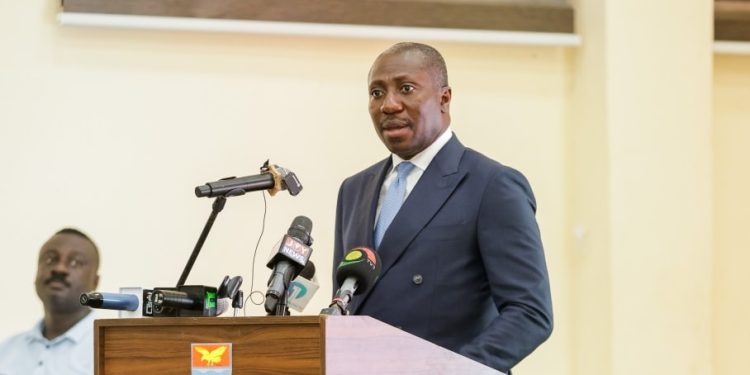
Minority Leader Alexander Afenyo-Markin has made serious allegations against Chief Justice Paul Baffoe-Bonnie, accusing him and other Supreme Court judges of being part of a “grand conspiracy” that led to the removal of former Chief Justice Gertrude Torkornoo.
Mr Afenyo-Markin claims that some judges deliberately worked against Justice Torkornoo to pave the way for a change in the leadership of the Judiciary. He has also suggested that if the NPP returns to power, Justice Torkornoo could be reinstated.
These are very serious allegations. However, the crucial question is: What evidence has been presented to support them?
Public officials, particularly senior political leaders, have the right to criticise institutions and demand accountability. But allegations of conspiracy involving judges should ideally be supported by credible evidence, documents or findings from a competent investigative or judicial process.
Without evidence, there is a danger that allegations can be interpreted by the public as established facts when they remain claims or accusations.
Can Afenyo-Markin be arrested?
Making a political allegation does not automatically mean that a person can or should be arrested. Whether his statements amount to a criminal offence would depend on the exact words used, the circumstances, applicable Ghanaian law and whether the necessary legal elements of an offence are established.
The appropriate response to a serious allegation should therefore not be an immediate arrest simply because the Judiciary has been criticised.
If the allegations are false or defamatory, affected individuals may have legal remedies. If the statements potentially amount to contempt or another offence, the relevant authorities would have to determine that through due process.
Is this misinformation?
It would be premature to label the Minority Leader’s statements as misinformation merely because they have not been independently proven.
A more accurate description is that he has made allegations that require evidence and verification.
The media and the public must therefore distinguish between “Afenyo-Markin alleges…” and “Judges conspired to remove Torkornoo.” The first accurately reports a claim; the second presents the claim as an established fact.
Could this undermine confidence in the Judiciary?
Yes, potentially.
The Judiciary depends heavily on public confidence. When a senior political figure accuses Supreme Court judges of conspiring to remove a Chief Justice for personal or institutional interests, without publicly presenting evidence, some members of the public may begin to question the independence and integrity of the courts.
That does not mean criticism of the Judiciary should be discouraged. A democratic society must allow scrutiny of judicial decisions and processes.
But criticism should be accompanied by facts, evidence and responsible language especially when the allegations concern the highest court in the land.
Why the allegation is serious
The allegation is serious because it concerns the removal of a Chief Justice, the conduct of Supreme Court judges and the integrity of Ghana’s judicial system.
Justice Torkornoo’s removal followed the constitutional process under Article 146, and the fairness and transparency of that process can legitimately be debated. However, alleging that judges deliberately conspired to remove their own Chief Justice goes beyond ordinary political criticism.
If Mr Afenyo-Markin has evidence of such a conspiracy, the public interest demands that the evidence be properly presented to the appropriate institution rather than left as a political accusation.
At the same time, the government and Judiciary should not respond to criticism by simply dismissing every allegation as political propaganda. Transparency is the best way to protect public confidence.
Ultimately, Ghana needs neither blind loyalty to the Judiciary nor reckless attacks against it.
We need evidence, accountability, due process and responsible public discourse.
When allegations involve the Chief Justice and Supreme Court judges, the stakes are too high for speculation. The truth must be established through evidence—not political rhetoric.
The question Ghanaians should be asking is simple: If there was truly a “grand conspiracy,” where is the evidence?