Ghana’s Galamsey Crisis: A fight that demands stronger government action
Written by; Regina Bless
Illegal mining, popularly known as galamsey, has become one of Ghana’s most serious environmental and public health challenges. Although successive governments have announced campaigns and measures to fight illegal mining, the continued destruction of forests, rivers and farmlands raises a difficult question: Is the government really doing enough?
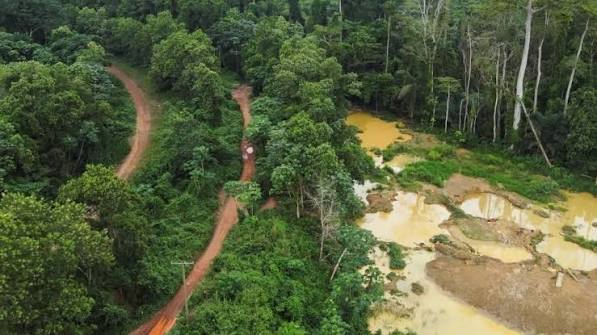
Across the country, illegal mining activities are turning once-clean rivers into polluted waterways. Forest reserves and farmlands are also being destroyed in the search for gold. The consequences go beyond the environment. They are increasingly becoming a threat to the health and future of the population.
Our Water Is Under Threat
One of the greatest dangers of galamsey is the pollution of Ghana’s water bodies. Rivers that serve as important sources of water for communities are being contaminated by mining activities, sediment and harmful substances.
If the destruction continues at its current pace, Ghana could face an increasingly expensive water crisis. In the future, communities may have to depend more heavily on treated or imported water because some local water sources may no longer be safe or economically practical to use.
The idea of Ghana having to import water may sound extreme, but the warning is clear: when we destroy the natural sources that provide our water, we eventually have to pay heavily to replace what we have lost.
Galamsey Is Also a Public Health Issue
The effects of illegal mining are not limited to damaged landscapes. Mining communities can be exposed to hazardous substances used or released during mining and gold-processing activities. Some substances, including mercury, can be particularly dangerous when exposure is prolonged.
Such exposure can affect the nervous system and other organs, with children and pregnant women among groups that can be especially vulnerable. Contaminated food and water can also become pathways through which pollutants enter the human body.
There are also serious concerns about environmental pollution and reproductive health. Exposure to certain toxic substances has been associated in scientific research with adverse pregnancy outcomes and developmental problems. This makes environmental protection an important part of protecting mothers, babies and future generations.
However, claims that galamsey chemicals are directly responsible for specific birth deformities in Ghana should be investigated carefully through proper medical and scientific studies rather than assumed in every individual case. The potential health risks are serious enough to demand evidence-based action.
Government Must Do More
The government has taken steps against illegal mining, including enforcement operations, arrests and efforts to protect water bodies. But the persistence of the problem suggests that enforcement alone has not been enough.
There must be sustained action rather than campaigns that receive attention for a few months before illegal mining returns. Law enforcement agencies must have the resources and independence required to enforce mining and environmental laws. Anyone involved in illegal mining—including those who finance, facilitate or profit from it—should face the law.
At the same time, communities need realistic economic alternatives. For some people, illegal mining provides an income when other opportunities are limited. Tackling the problem therefore requires not only enforcement but also jobs, responsible mining opportunities, land restoration and stronger local economic development.
We Cannot Trade Our Future for Gold
Ghana’s natural resources are valuable, but gold should not come at the cost of clean water, healthy communities and future generations.
The galamsey crisis should therefore be treated as an environmental, economic and public health emergency. The government must demonstrate stronger and more consistent leadership, while citizens, traditional authorities, mining companies and communities must also play their part.
If Ghana waits until its rivers are completely destroyed before acting, the cost of restoring them could be enormous. We should not reach a point where future generations ask why we allowed valuable water sources to disappear while chasing gold.
The fight against galamsey must be a fight for Ghana’s water, health, environment and future.